Iron in well water: what orange and brown stains mean
Dissolved iron, oxidized iron and iron bacteria all stain your laundry orange and all get quoted the same tank by somebody in a hurry. They need different equipment, and one of them is alive and cannot be filtered out at all. You can tell them apart at your own sink in ten minutes.
In short
- Clear water that turns orange is dissolved iron, water already orange is oxidized iron, and slime in the toilet tank is iron bacteria.
- Iron is regulated for staining and taste, not for health.
- Iron bacteria needs the well and plumbing disinfected. A filter or softener will not fix it.
The glass test
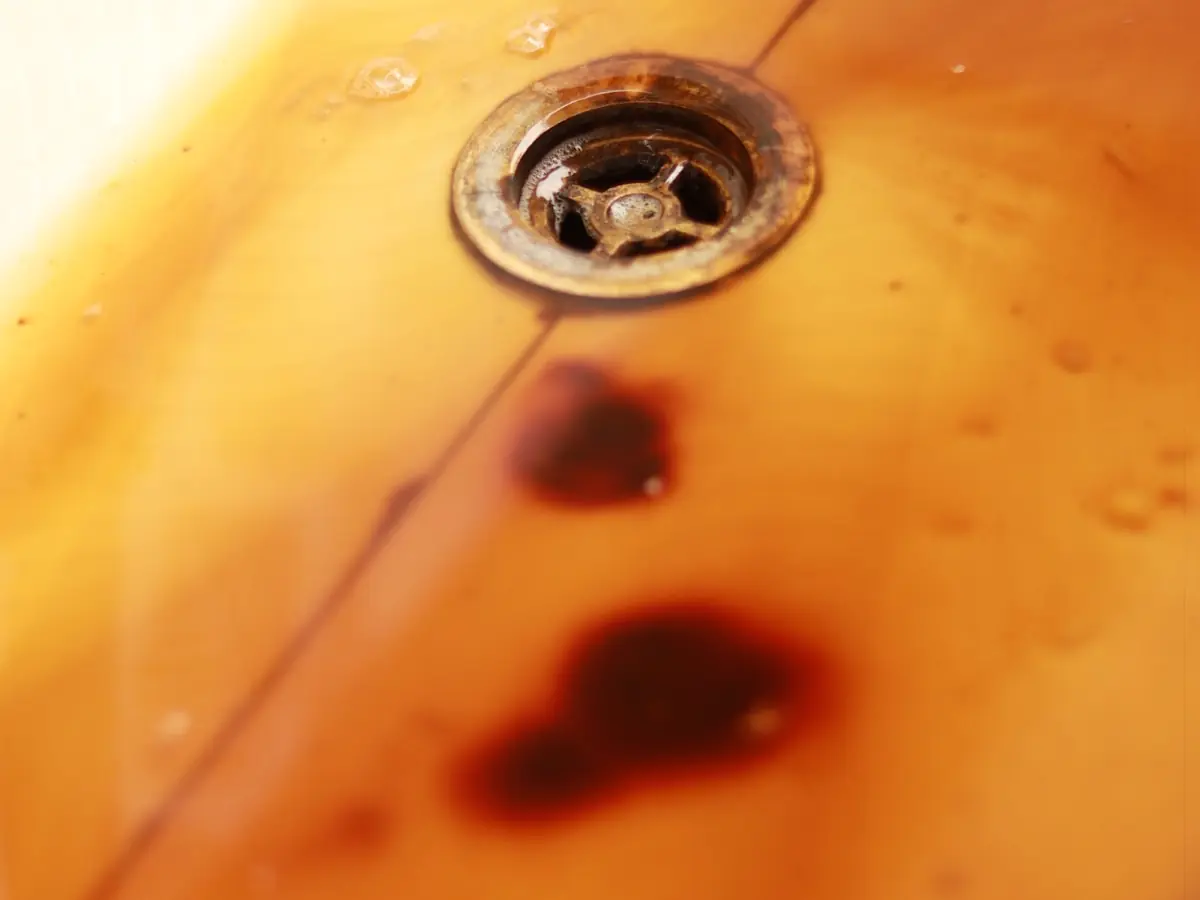
Clear water that turns orange as it stands is dissolved iron. Water that comes out of the tap already orange is oxidized iron. Reddish slime and an oily film in the toilet tank is iron bacteria, which is alive and which no filter removes. Half an hour on the counter separates the first two, and the staining threshold behind all three is 0.3 milligrams per liter.
Fill a clear glass from a cold tap that comes off the line before any treatment equipment. Look at it immediately, then leave it on the worktop and look again after half an hour. What changes in that half hour is the diagnosis.

| In the glass | It is | Why it stains | Treated with |
|---|---|---|---|
| Clear at first, orange sediment after standing | Dissolved, or ferrous, iron | Invisible in the water, oxidizes on contact with air, so it stains after it leaves the tap | Oxidation then filtration: an oxidizing filter, or aeration and a filter. A softener only at low levels. |
| Orange or cloudy straight from the tap | Oxidized, or ferric, iron | Already a particle by the time it reaches you | Filtration. It is already in a form a filter can catch. |
| Reddish slime, an oily rainbow film, a smell | Iron bacteria | A living colony in the well and pipework producing the slime | Disinfection of the well and system, usually shock chlorination, then ongoing treatment. Filters do not fix it. |
Lift the lid on a toilet tank that does not get used much. Iron bacteria leave a reddish-brown slime on the walls and often an oily-looking sheen on the surface. Plain iron leaves a dry orange stain and no slime. That one look separates a filtration problem from a disinfection problem.
Is iron in well water dangerous?
No. Iron sits in the EPA's secondary standards at 0.3 milligrams per liter, a threshold set for rusty color, metallic taste and orange staining rather than for health. The results that decide whether your water is safe to drink are bacteria and nitrate, and the color of your laundry tells you nothing about either.
Iron is a secondary contaminant, which means it is regulated on taste, color and staining rather than on health effects. It will ruin a load of white laundry, mark every fixture in the house and make coffee taste metallic long before it does anything to you.
The things in well water that do matter for health, principally bacteria and nitrate, have no color, no taste and no smell. Which is the real argument for testing: the problem you can see is not the one worth worrying about, and the one worth worrying about is invisible.
UF/IFAS Florida-Friendly Landscaping, Iron in water · Florida Department of Health, Private well water testing
Iron · 0.3 mg/L · rusty color; sediment; metallic taste; reddish or orange staining
US EPA, National Secondary Drinking Water Standards
US EPA, Secondary drinking water standards: guidance for nuisance chemicals
Iron bacteria, and why it is its own category
Iron bacteria are not a health hazard in themselves. They are an operational one. The colony produces slime that coats the inside of the well casing, the drop pipe, the pressure tank and any filter you install, and it will clog equipment you have just paid for.
It also masks other problems. Slime in the system makes bacteria testing harder to interpret and can shelter other organisms, which is why the standard answer is to disinfect the well and the whole system rather than to filter the symptom. That is a job for somebody who does it regularly, and it is one of the few well problems where doing it badly makes it worse.
Softener resin will hold a small amount of iron and manufacturers publish a limit. Past it, the iron fouls the resin, the softener stops softening, and you have bought a machine that now needs cleaning as well as a machine that still does not solve the iron. Get the raw water iron figure before anybody proposes one.
What to do next
Do the glass test, look in the toilet tank, then get a test that gives you total iron, dissolved iron and pH. pH matters because it changes how readily iron oxidizes, which changes which equipment works. How to get a Marion County sample tested, which filter matches which iron, and how iron fits with sulfur and hardness in one system.
Questions
The ones people search for
How do I know if my well water is high in iron?
The visible signs are orange or brown staining on fixtures, in the toilet bowl and on laundry, a metallic taste, and tea or coffee that looks off. Those tell you iron is present but not how much, and the amount is what chooses the equipment.
For that you need a test giving total iron, dissolved iron and pH. The first two together tell you which form you are dealing with, which the glass test also shows you for free.
Is it safe to drink well water that has iron in it?
Iron is regulated as a secondary contaminant, on aesthetics rather than health. At the levels that stain a bathroom it is not a health problem.
The caution is that heavy staining often travels with other things, and iron bacteria in particular is a sign of conditions in the well worth a proper bacteria test. Test rather than assume, in either direction.
How can I get rid of iron in my well water?
By first establishing which of the three you have. Dissolved iron needs oxidizing before it can be filtered, usually with an oxidizing filter or aeration. Oxidized iron is already a particle and needs filtration. Iron bacteria needs the well and system disinfected, because it is a living colony rather than a mineral.
The glass test at the top of this page distinguishes the first two, and the toilet tank gives away the third.
What are the symptoms of too much iron in well water?
Orange or rust-colored staining on sinks, baths, toilets and laundry; a metallic taste; dark or muddy-looking tea and coffee; and staining on anything irrigated with the same water, including driveways and the side of the house.
Iron bacteria adds slime in toilet tanks and pressure tanks, an oily surface film, and a musty or swampy smell that people often mistake for the separate sulfur problem.
Will a whole house filter remove iron bacteria?
No. A filter removes particles from water passing through it. Iron bacteria is a colony living on the surfaces of the well, the pipework and the equipment itself, so it re-establishes downstream of anything you fit.
The treatment is disinfection of the well and the whole system, commonly shock chlorination, usually followed by ongoing treatment to stop it coming back. Ask specifically whether a quote includes disinfecting the well, not just fitting equipment.
Before you hire anyone
Calling a well contractor? Check three things first.
- 1The license. Every Florida water well contractor is licensed. Ask for the number and look it up at the state's contractor verification clearinghouse.
- 2The diagnosis before the price. A pressure switch reading, the tank's air charge and the cable readings, before anybody quotes a new pump. The six questions to ask.
- 3The permit, if a rig is coming. A new well needs one before drilling starts, and it is the contractor's job to have it. Who issues it.
Public offices, free to call
Ocala Well Water is an independent guide. It takes no calls, collects no details, and no company pays to be mentioned. How this site works.